
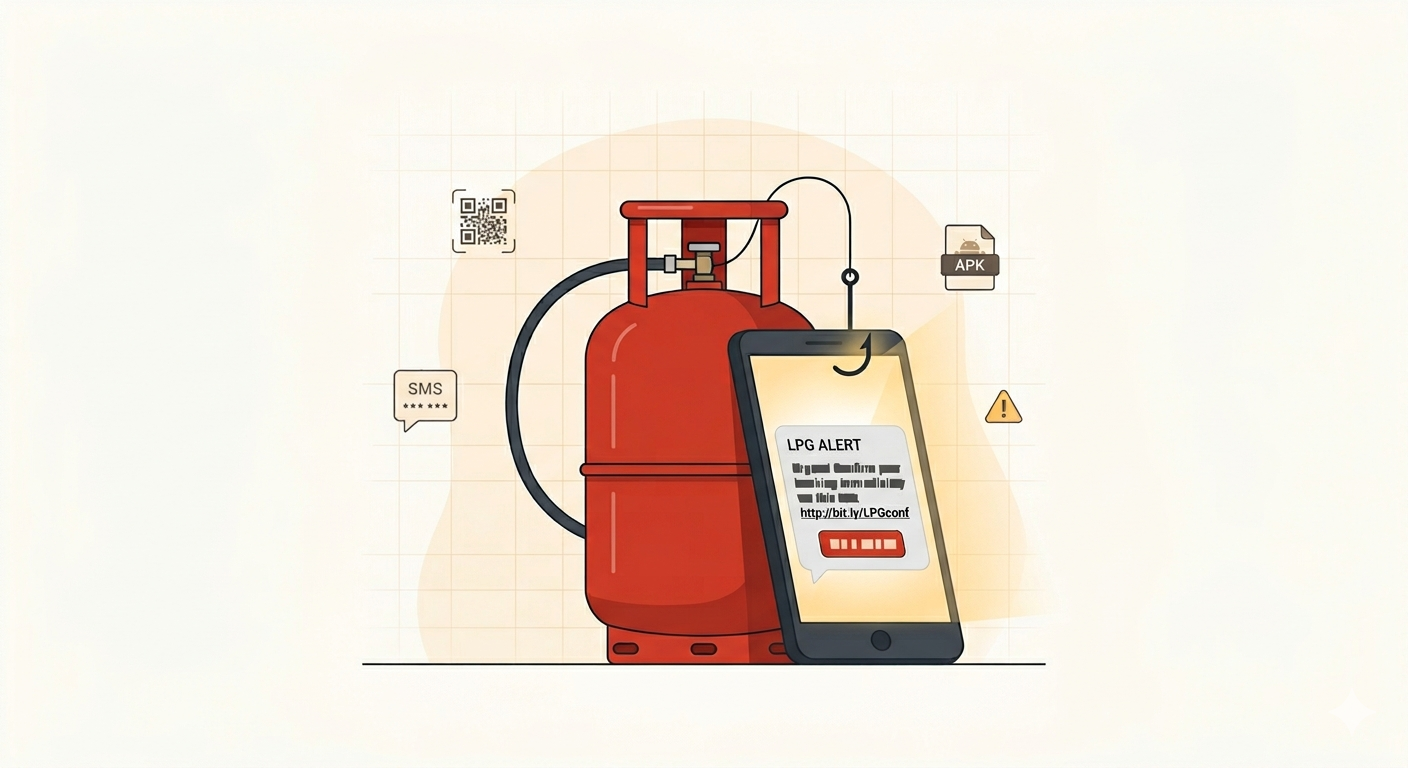
LPG scams are not new, but they have surged in 2026. As fears of a shortage spread following disruption in the Strait of Hormuz, scammers have built fake booking websites, sent SMS and WhatsApp links posing as gas agencies, and circulated APK files that drain bank accounts once installed. The Ministry of Petroleum and Natural Gas has urged consumers to avoid panic booking, noting that existing refill timelines (25 days urban, 45 days rural) remain unchanged.
In Himachal Pradesh alone, the state recorded 18,706 cybercrime complaints in 2025, up from 12,249 the previous year and 8,077 in 2023. LPG scams are a small but visible part of that rise, and the modus operandi is consistent across states.
How it works
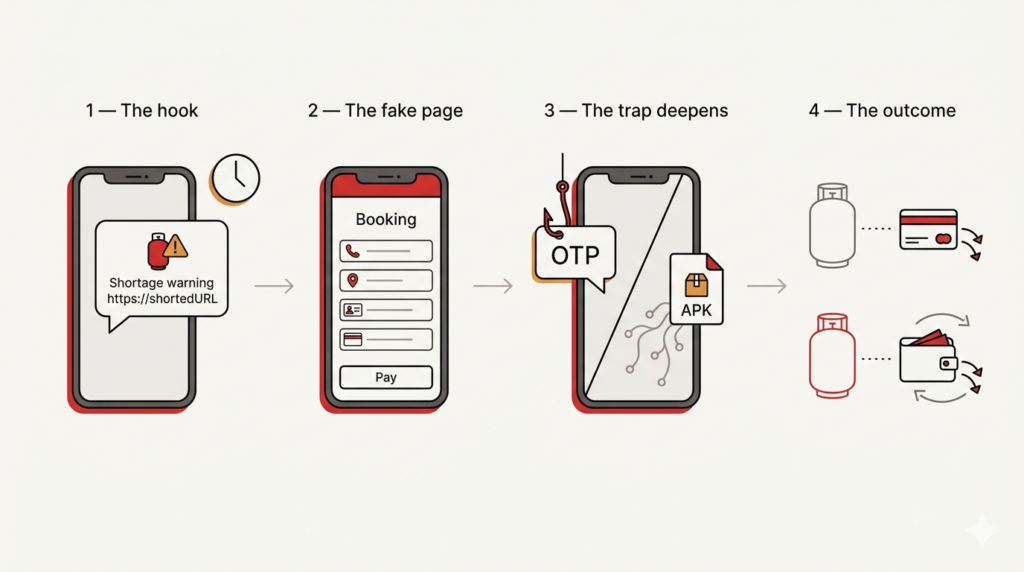
The script almost always opens with shortage messaging. Scammers send a text or WhatsApp forward citing the conflict in West Asia, the Strait of Hormuz, or a vague “supply crisis”, and warn that LPG cylinders must be booked in advance. The message includes a link to what looks like an official booking page.
On the page, victims are asked for their mobile number, address, LPG ID, and bank or UPI details. A small “booking fee” or “advance payment” follows. Some variants ask for an OTP to confirm the booking. Others push the user to download an APK file or scan a QR code, which installs malware capable of reading SMS and intercepting OTPs.
Once the credentials are submitted, the booking never arrives. The money is gone, and in cases involving APK installs, the loss continues for as long as the malware sits on the phone.
The Ministry of Petroleum and Natural Gas has also flagged a second strand of misinformation: forwards claiming the government has revised LPG booking timelines (most recently to 35 days for non-PMUY double-bottle connections). The ministry has called these reports false and urged citizens not to circulate them:
Common variants
- Fake booking links over SMS and WhatsApp: Messages claim to offer “instant delivery”, “next-day refill”, or “emergency supply”. Links lead to look-alike websites that ask for UPI PINs or card details. Genuine distributors never ask customers to make payments through SMS or WhatsApp links.
- Fake gas agency calls: A caller claiming to be from Indane, Bharat Gas, or HP Gas warns of an imminent supply cut and offers to secure a cylinder if the customer pays now. If the customer hesitates, the caller threatens to give the slot to someone else. No real gas agency books cylinders by calling consumers.
- APK files and QR code scams: Scammers send a file named something like Indane_Booking.apk or a QR code that claims to open the booking app. Installing the file gives the scammer access to SMS, contacts, and screen activity. This is the most damaging variant because the loss is not a one-off payment but ongoing access to the victim’s phone.
- Subsidy and cashback bait: Social media ads promise cashbacks on LPG bookings or discounted cylinders for PMUY beneficiaries. The ads route to forms collecting Aadhaar, bank details, and OTPs. PMUY beneficiaries are disproportionately targeted because the scheme involves real subsidy transfers, which makes the cover story plausible.
How to tell if something is a scam
- No gas agency books cylinders through random links sent over SMS or WhatsApp. If a message asks you to click a link to book or pay, it is a scam.
- Genuine booking only happens through registered mobile numbers and official channels. For Indane, IVRS on 7718955555, missed call to 8454955555, or “REFILL” to 7588888824 on WhatsApp. For Bharat Gas, IVRS on 7715012345 or 7718012345. For HP Gas, IVRS on 8888823456 or missed call to 9493602222. Bookings can also be made through the IndianOil ONE, Bharatgas, or HP Pay apps, or the UMANG app.
- Anyone asking for an OTP, UPI PIN, or card details to confirm a booking is a scammer. Distributors never need any of this.
- Do not install APKs from links. The Play Store and App Store are the only safe sources for booking apps.
- If a forward claims new LPG rules or timelines, check the Ministry of Petroleum and Natural Gas handle before acting on it. Most of the rule-change forwards circulating in 2026 have been confirmed as fake by the ministry.
If you have already shared details
Speed matters. The Indian Cyber Crime Coordination Centre (I4C) refers to the first hour after a fraud as the “golden hour” because the 1930 helpline can coordinate with banks to freeze suspect accounts before money is moved out of the digital ecosystem. In Mumbai alone, the 1930 helpline blocked or recovered roughly ₹202 crore for victims in 2025. Call 1930 immediately and file a complaint at cybercrime.gov.in. Block the affected card or UPI ID through your bank’s app or helpline. If an APK was installed, factory reset the phone after backing up clean data.
You can report any cybercrime incidents to the National Cybercrime Helpline by dialling 1930. You can also visit the National Cybercrime Reporting Portal at cybercrime.gov.in to register your complaint online.