
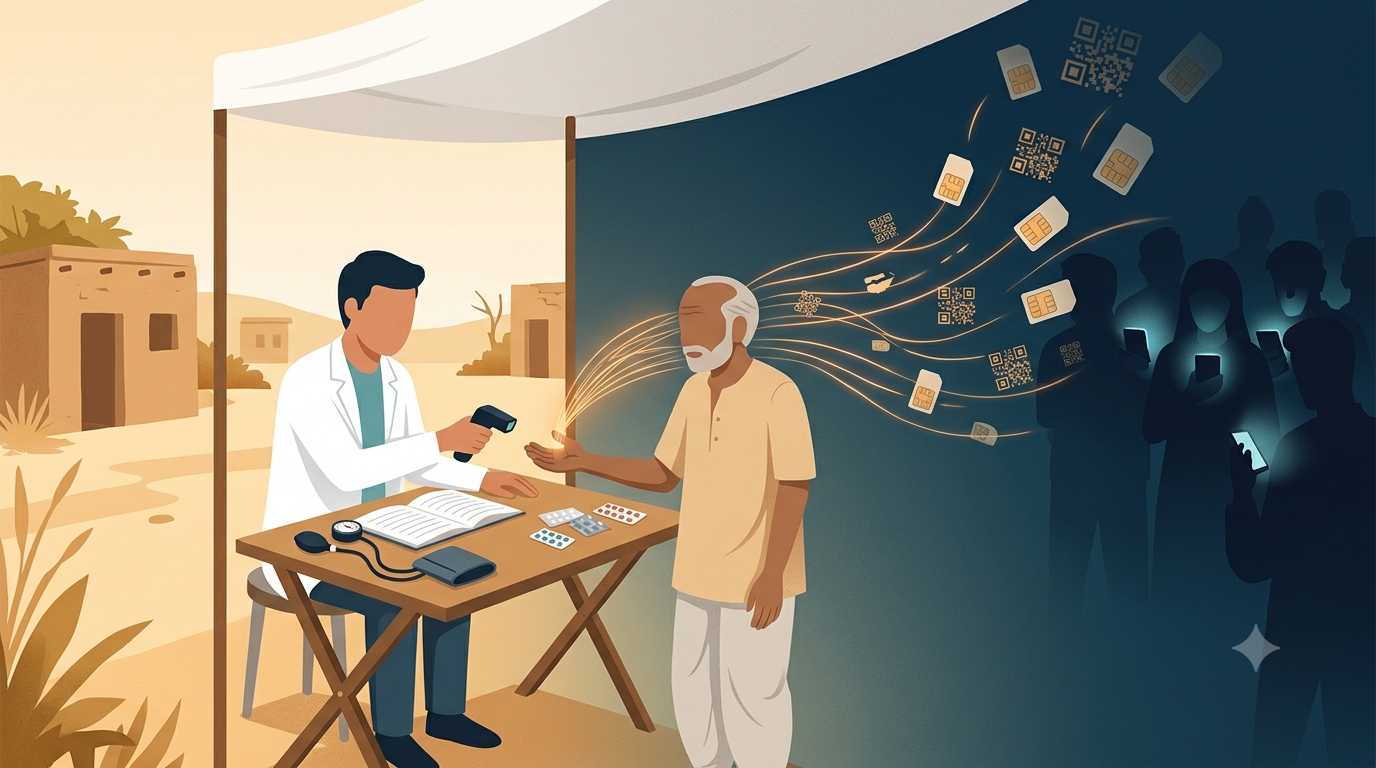
A free blood-pressure check. A strip of medicines at half the price. A friendly “nurse” who just needs a copy of your Aadhaar card and a quick thumbprint “for the register”. For hundreds of villagers in Uttar Pradesh, that is what a health camp looked like this year. According to the Delhi Police, it was something else entirely: a collection counter for identities that were later turned into SIM cards for cybercriminals.
Quick question before you read on: when did you last check how many mobile numbers are registered in your name? Hold that thought. We will come back to it.
What happened
The Delhi Police’s Intelligence Fusion and Strategic Operations (IFSO) unit, part of the Special Cell, has arrested two men from Mathura, aged 29 and 21, for allegedly running fake health camps in villages to collect residents’ Aadhaar and biometric details. Police say those details were then misused to obtain SIM cards and e-SIMs, which were sold on to fraudsters.
The numbers reported so far are striking:
- 3,000+ SIMs: the duo is suspected of activating more than 3,000 SIMs over the past year, handling roughly 20 to 30 e-SIMs a day.
- ₹2.64 crore: SIMs linked to the pair have been tied to more than 20 complaints on the National Cyber Crime Reporting Portal, involving suspected fraud of about ₹2.64 crore.
- ₹800 in, ₹2,000 out: police say activated e-SIMs were bought for ₹800 to ₹1,200 and resold for around ₹2,000, with QR codes passed along through Facebook, Instagram and Telegram, and payments made in the cryptocurrency USDT.
.
How a health camp ends in a “digital arrest”
This case did not begin in a village. It began in Delhi, with a resident who was kept under so-called “digital arrest” for nearly two weeks. Fraudsters posing as officials threatened him with legal action over a series of video calls and pressured him into transferring ₹1.64 crore through six RTGS transactions into six bank accounts. When investigators traced the phone numbers and device data used in the scam, the trail led to the Vrindavan–Mathura region.
Put the pieces together and the chain looks like this:
- The bait: a free or cheap health service in a village, where people trust the setup and rarely question paperwork.
- The harvest: Aadhaar or voter ID copies, plus fingerprints or other biometric details.
- The conversion: those details are used to obtain SIM cards or e-SIMs in the villagers’ names, without their knowledge.
- The sale: e-SIM QR codes are sold online to fraud networks.
- The scam: a stranger’s phone call, “from the police” or “from TRAI”, reaches a victim from a number that traces back to an innocent villager.
That last step is the part worth sitting with. The person whose name is on the SIM may never know it exists, and may be the first person the police come looking for.
According to police, the two accused started out as middlemen connecting SIM sellers with buyers on social media, before setting up the camps to create their own supply. Investigators are also examining communications with foreign-based contacts and possible links to SIM-box systems.
Why this should worry all of us
We usually think of identity theft as something that happens online: a leaked database, a phishing link, a hacked account. This case is a reminder that some of the most effective data theft is low-tech and face-to-face. It relies on goodwill, on the trust people place in anything that looks like healthcare, and on the fact that handing over an Aadhaar photocopy has become an everyday habit.
It also shows how one person’s identity becomes another person’s loss. A fingerprint given at a camp in one state can end up powering a fraud call to a retiree in another.
The Delhi Police has urged citizens not to share Aadhaar OTPs or SIM activation codes with unknown individuals. Here is how to go a step further.
Safety advisory: Before You Share Your ID
- Ask who is running the camp: Genuine health camps are usually organised by government hospitals, primary health centres, ASHA or Anganwadi workers, or known NGOs or private entities. If no one can tell you which organisation is behind it, keep digging.
- Ask why they need it: A blood-pressure or sugar test does not need your fingerprint. If a service has nothing to do with identity, be wary of anyone who insists on your Aadhaar and biometrics.
- Share less, not more: Where ID is genuinely required, use a masked Aadhaar or Virtual ID (VID) instead of your full Aadhaar number.
- Mark your photocopies: write the purpose and date across any ID copy you hand over (for example, “For hospital registration only, 30/10/2026”). It makes misuse harder.
What to Avoid
- Biometric “retakes”: Be cautious if someone asks for your thumbprint again because “the machine didn’t work”. SIM frauds in the past have used repeated fingerprint scans to activate extra SIMs in a customer’s name.
- Photos of your documents: Do not let strangers photograph your Aadhaar, voter ID or PAN on their personal phones.
- Sharing codes: Never share Aadhaar OTPs, SIM activation codes or e-SIM QR codes with anyone, including people who say they are officials.
- “Renting” your SIM or ID: offers of quick cash for a SIM in your name or for the use of your documents are how fraud networks get their supply. The number, and the trouble, stay in your name.
Take two minutes: Is your identity already being used?
Remember that question at the start? Here is how to answer it.
- Check your mobile connections: On the Department of Telecommunications’ Sanchar Saathi portal, open “Know Mobile Connections in Your Name”, log in with your number and OTP, and review every number listed. Mark any you don’t recognise as “Not my number”.
- Check your Aadhaar authentication history: Log in to myAadhaar to see when and where your Aadhaar was used for authentication. Anything unfamiliar is worth reporting.
- Lock your biometrics: You can lock your fingerprints and iris data through myAadhaar or UIDAI’s official app, and unlock them for a short window only when you need them, such as at a bank or a telecom store. If you use biometrics for rations, remember to unlock before you go.
This is the easy part for most of us. The harder part is making sure our parents, grandparents and relatives in smaller towns and villages, the people most likely to walk into a free health camp, know about these tools too. This weekend, consider sitting with one of them and running the checks together.
What Can You Do If It Happens?
- Report unknown numbers: Flag any connection you did not take on Sanchar Saathi so your operator can re-verify and disconnect it.
- Lock and complain: Lock your biometrics right away and raise a complaint with UIDAI on its helpline, 1947.
- Report suspicious calls: Use Chakshu on Sanchar Saathi to report fraud calls and messages.
- Remember: there is no such thing as a “digital arrest”: No police force, court or agency arrests anyone over a video call or asks for money to “verify” your accounts. Disconnect, do not transfer money, and report immediately.
- Save evidence: Keep screenshots, call logs, numbers, transaction IDs and the details of where you shared your documents.
- Report to police: If money is lost, call 1930 at once. Speed matters for freezing funds.
The bigger lesson
The lesson here is not to stop going to health camps. Most are run by people genuinely trying to help. It is to treat your Aadhaar, your fingerprint and your phone number as what they really are: the keys to your identity, not a formality you hand over in exchange for a free check-up.
If you have been a victim of cyber fraud, call the National Cybercrime Helpline at 1930 or report it at cybercrime.gov.in.